
Twin Falls Reentry Custody Status
The Idaho Department of Correction operates Twin Falls Community Reentry Center at 616 Washington Street South in Twin Falls. It is outside Jerome County, but it serves the wider Magic Valley and can be relevant to people returning toward Jerome. The facility houses up to 160 minimum-custody men who are nearing release. Its official history says it opened in 2020.
A move into the center is not a release from IDOC. The resident remains confined under state authority and should ordinarily appear as “In custody” in the Resident/Client Search. Community reentry centers can provide structured work and transition opportunities, yet that purpose does not change the legal custody status. Calling placement “released” would erase a crucial step in the correction record.
Custody point: Reentry-center placement remains IDOC custody until the state record reflects an actual community or discharged status.
Confirm Twin Falls Reentry Release
The IDOC Resident/Client Search is the main public route. It covers people in IDOC custody, people on state-supervised parole or probation, and names of people whose sentences are satisfied. Search by last name or IDOC number. A partial name requires at least two last-name characters, while a partial IDOC-number search needs the first three digits. Add the first name and compare birth year to avoid confusing people who share a name.
- Search the person's last name or IDOC number and narrow the result with first name.
- Match the IDOC number, name, and birth year before reading the status.
- If the status is “In custody,” open the detail and verify the listed IDOC location.
- If it says “In community,” inspect each case for Parole or Probation and a Released to Supervision date.
- If it says “Discharged” with a date, treat that as the endpoint of IDOC jurisdiction, subject to any separate case.
IDOC warns that the database is updated daily and that fast-changing location, status, or scheduled-termination information may not yet be current. A public-record request or direct IDOC contact can resolve a high-stakes timing question. Do not turn the daily update notice into a promise of real-time reporting.
Twin Falls Release Status Fields
Read the result as a sequence, not as one universal release date. “In custody” describes the resident's current state authority. “In community” means the person is outside an IDOC institution under a community status, but the case must show whether that status is parole or probation. Parole generally follows prison custody. Probation can begin through a court sentence without a state-prison stay, so it does not by itself prove release from this center.
| IDOC field | Meaning for this center |
|---|---|
| In custody | The person remains under IDOC custody, including a reentry-center placement |
| In community + Parole | Supports release from state custody to parole supervision |
| Released to Supervision | The date most recently placed on court or Commission supervision |
| In community + Probation | Shows supervision but not necessarily a prior prison release |
| Discharged [date] | IDOC jurisdiction ended on the stated date |
| Active Bench Warrant | An unresolved supervision issue, not discharge |
When several cases appear, read each one. One satisfied sentence does not automatically end another active matter. A detainer or receiving-agency record can also mean the person left the center but did not enter the community. The public result should be reconciled with the detail page and, when needed, the sentence record.
Twin Falls Reentry Center Contact
The center's official facility page supplies its identity, address, phone, custody level, and capacity. Facility staff can answer current operational questions within disclosure limits. Release eligibility, sentence calculation, jail credit, or final discharge records belong with the proper IDOC records unit, not Jerome County Sheriff's Office.
Twin Falls Community Reentry Center
616 Washington Street South
Twin Falls, ID 83301
208-644-7900
Operator: Idaho Department of Correction
Type: minimum-custody community reentry center
For a written state record, begin with the JustFOIA portal linked by IDOC Sentencing Records. If the online route fails, IDOC Public Records can be reached at 208-658-2134, and central office at 208-658-2000. Describe the person by name and IDOC number, state the date range, and request the exact status, location, release-to-supervision, sentence-satisfaction, or discharge record needed.
Jerome Cases at Twin Falls
Jerome County falls within IDOC District 5, whose main office is also in Twin Falls. That geographic link makes the center locally useful, but it does not mean every Jerome case goes there. IDOC controls placement based on its custody and transition process. Men entering state custody generally pass through reception elsewhere, and many will never be assigned to this community reentry center.
A Jerome County Jail transfer to IDOC should first be established with the court commitment and the sheriff's release or transfer entry. Then the IDOC record can show the state-custody phase. If the detail later lists Twin Falls Community Reentry Center while the status remains “In custody,” the person has changed facilities without being released. The Jerome County Jail release record addresses the county side of that chain.
- County transfer
- Jerome custody ends and IDOC custody begins under a commitment.
- Reentry placement
- The person lives at the center while remaining in minimum state custody.
- Parole release
- The person enters the community under Commission and IDOC supervision.
- Discharge
- The sentence is satisfied and IDOC jurisdiction ends.
Work Release Is Still Custody
The center's work-release and transition role can cause confusion. A resident may take part in approved work or community programming while remaining confined under IDOC rules. Permission to leave for a set activity is not the same as release from the sentence. The state status, facility placement, and case status must be read together.
Likewise, “Released to Supervision” is useful only in context. IDOC defines it as the most recent date a person was placed on supervision by a court or the Parole Commission. With “In community” and a Parole case, it supports an actual prison-to-parole transition. With Probation, it may reflect a court order that did not follow incarceration. The difference guards against assigning a prison history that the public record does not establish.
Twin Falls Release Timing Evidence
A parole eligibility date is only the point when parole may be considered. A hearing date schedules Commission review. A tentative parole date remains conditional on required steps, institutional conduct, release planning, and any holds. None proves that the resident has left. After the expected date, look for the actual status change and Released to Supervision field.
Idaho's fixed and indeterminate sentence structure also means there is no blanket 85-percent formula to apply. The judge-set fixed term ordinarily must be served before parole eligibility. The Commission decision is prospective, while the later IDOC community status is event evidence. A Sentence Satisfaction Date points to a later endpoint and may change as authorized calculations or case events change.
Before expected release
Review parole eligibility, hearing information, Commission action, and any tentative date.
After expected release
Confirm “In community,” Parole, and Released to Supervision, or a dated discharge.
Twin Falls Facility Source
The official IDOC facility page is the proper source for the center's current contact and program description.
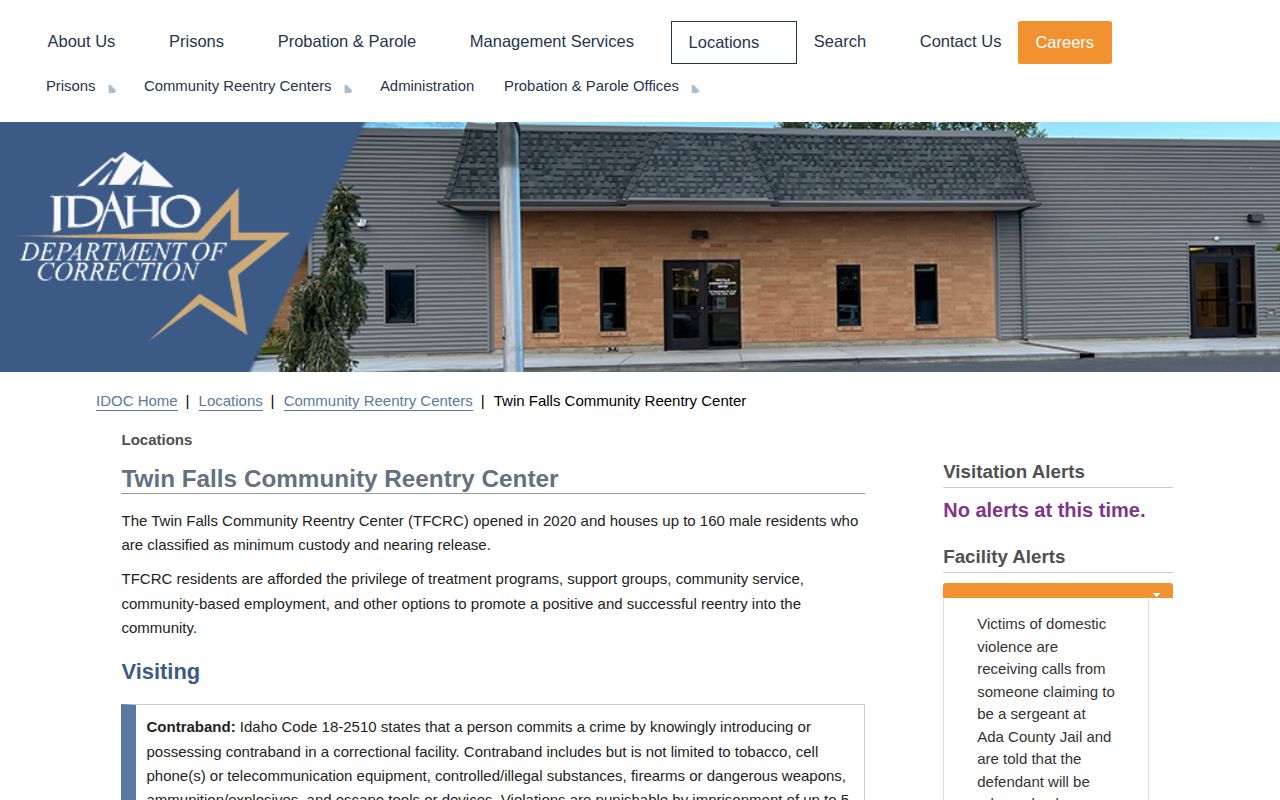
For a named person's status, return to the Resident/Client Search rather than treating the general facility page as a roster. For exact calculations or archived state records, use IDOC Sentencing Records and Public Records.
Twin Falls Record Requests
A precise IDOC request should identify the resident by full name and IDOC number, then state the date range and record sought. Useful items can include location history, sentence calculation, release-to-supervision information, or final discharge. Ask for electronic delivery and an estimate if research will create an authorized cost. IDOC may withhold or redact protected material, so a public result should never be treated as the complete correction file.
Commission hearing notices answer a related but separate question. A grant or tentative date records a decision and anticipated path. The later IDOC status change confirms whether the resident actually entered the community.