
Jerome Scheduled and Actual Release
A projected or scheduled date is a calculation or future procedural point. The actual date records when the person left that custodian. A pretrial detainee generally has no sentence endpoint because the court has not imposed a sentence. Bond, dismissal, a new order, or commitment to another agency may determine what happens next.
For a sentenced person, the source changes with custody. Jerome County Jail records and the court judgment control a county sentence. IDOC Sentencing Records calculates state terms. The Commission decides parole, but its tentative date remains conditional. A transfer ends custody at one facility without proving release to the community.
Find a Jerome Projected Release Date
First identify whether the person is in the county jail, IDOC custody, or another system. The live Jerome headcount establishes current county custody only. IDOC covers people committed to state correctional jurisdiction. Federal and immigration tools have separate scopes.
- Search the Jerome current headcount to establish whether county custody is current.
- Open iCourt with the case number or the name in “Last, First” form, then read the judgment and recent orders.
- For an IDOC resident, use the official Resident/Client Search and open the matching detail.
- Record each field exactly: PED, hearing date, satisfaction date, retained-jurisdiction end, or status.
- Search Commission notices for a parole decision and any tentative date.
- After the date, confirm the event through IDOC status or request the jail release entry.
The Jerome County released inmate search explains the complete county record chain. A no-match should lead to the next custodian, not a claim that the person is free.
Idaho Release Date Calculation
Idaho does not use a blanket rule that every person serves 85 percent. Under Idaho Code § 19-2513, the court sets a fixed portion and may add an indeterminate portion. The person ordinarily serves the full fixed term before ordinary parole eligibility. The fixed-term endpoint drives the Parole Eligibility Date.
Ordinary post-1986 good-conduct time does not shorten the fixed term. Section 20-101D allows a narrow extraordinary reduction for exceptional acts under statutory limits and rules. It is not routine monthly credit. Historical rules can matter to old offenses committed before July 1986.
IDOC Sentencing Records applies the judgment, credited presentence jail time, retained-jurisdiction credit, concurrent or consecutive structure, and parole forfeiture. The public date is the output of case-specific work, not a percentage to recalculate from a news report.
Why Jerome Release Dates Change
A date can change because the judgment, credit, custody destination, or parole decision changes. Public portals may also lag. Compare the newer official record with the older one rather than treating either as a promise.
| Factor | Effect | Best record |
|---|---|---|
| Jail or rider credit | Changes time credited | IDOC calculation and judgment |
| Concurrent or consecutive terms | Changes how terms combine | Judgment and IDOC record |
| Parole decision | May deny, continue, or set a TPD | Commission notice |
| Plan approval | May delay tentative parole | Commission and IDOC record |
| Detainer | May move the person to another custodian | Release disposition |
| Amended order | May alter the calculation | iCourt and certified order |
A detainer-only grant may end one placement while beginning custody under another agency. It is not community release.
Confirm Jerome County Actual Release
For a county-jail event, request the release date and time, disposition, receiving agency, and release order or receipt from the Jerome County Sheriff. The headcount is not an archive. Disappearance may mean release, transfer, correction, or a data change.
For state prison, recheck IDOC after the expected date. “In community” plus “Parole” and a Released to Supervision date supports release to parole. “Discharged” indicates the end of IDOC jurisdiction. “In custody” means the projected event did not become community release.
Idaho VINE can send a release or transfer event when registration occurs in time. The VINE Inmate Check covers alert limits. Use the agency record for the exact time, reason, or destination.
Jerome IDOC Release Date Fields
The official IDOC detail may expose several future dates. Each has a narrow use. Reading the labels prevents a hearing date from being reported as a release date.
| Field | Meaning |
|---|---|
| Parole Eligibility Date | Earliest ordinary parole consideration |
| Next Parole Hearing Date | A Commission procedure, not release |
| Sentence Satisfaction Date | Scheduled sentence endpoint |
| Retained Jurisdiction End Date | A rider event, not automatic release |
| Tentative Parole Date | Conditional Commission date |
The official IDOC example shows these date labels.
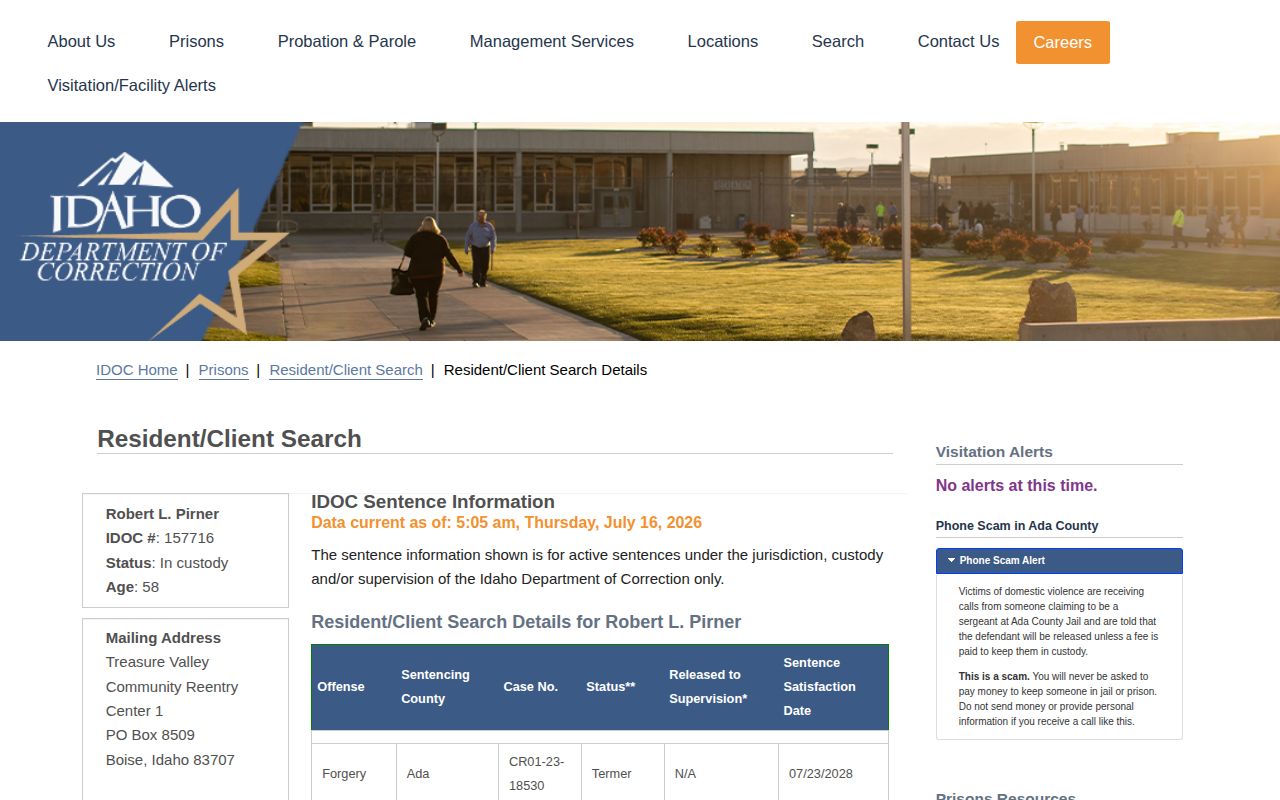
The image shows why every field must keep its official name.
Jerome Jail Sentence Dates
Do not apply the state-prison PED formula to a Jerome County Jail sentence. Start with the county judgment, credit for time served, commitment or release order, and jail calculation. Public sources do not publish a Jerome jail good-time policy, weekend-release rule, or universal release-hour policy.
Ask the jail or court for the calculation that applies to the case. The jail line is 208-595-3360. The Thomas H. Borresen Judicial Complex supplies court records, while the Sheriff retains the physical release entry.
A county sentence can end in transfer to IDOC or another custodian. Pair the county disposition with the receiving system’s status before describing the outcome.
Idaho Fixed-Term Release Quirk
Idaho’s distinctive rule is the full judge-set fixed term before ordinary parole eligibility, not a broad 85-percent formula. This makes the judgment’s fixed and indeterminate parts essential. The indeterminate part creates a range in which the Commission may consider parole, but parole is not presumed.
A TPD is still tentative. Programming, an approved plan, investigation, and paperwork must be complete. No one releases before that date, and a missed prerequisite may move or void it.
Jerome Parole Decision Sequence
The Commission schedule identifies sessions and daily orders. Its decisions page posts Notices of Action Taken. Outcomes include grant, deny, continue, pass to full term, revoke, new parole, and detainer-only action.
The useful timeline runs from PED to hearing, decision, conditional TPD, and actual status. Read the Commission decision, wait until the stated date, then confirm the IDOC update to community parole and Released to Supervision. If the record stays in custody, the future date did not prove release.
When records conflict, the IDOC Sentencing Records page describes the formal calculation route.
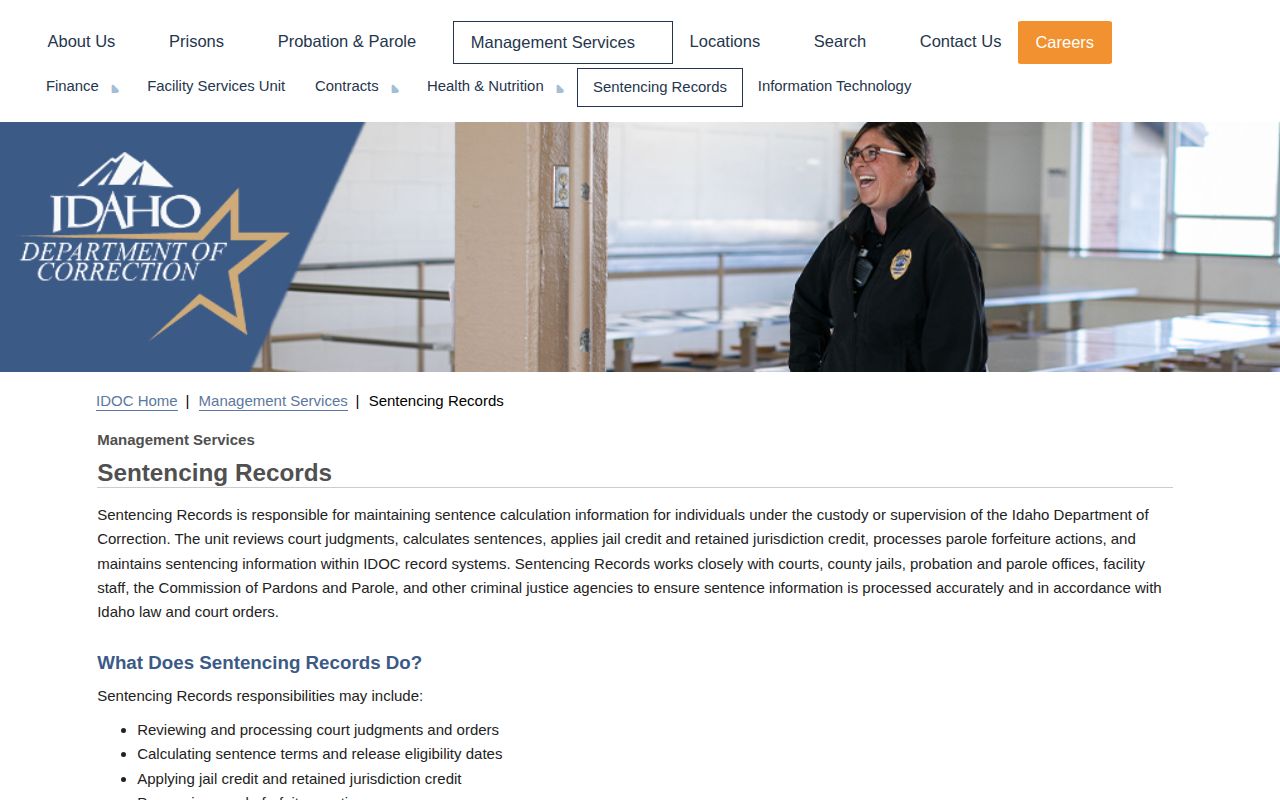
The office applies jail credit, retained-jurisdiction credit, and parole forfeiture instead of a guessed percentage.
Jerome Release Calculation Records
A public search offers useful fields, but a formal calculation may require the underlying record. IDOC Sentencing Records routes requests for sentence calculations, release eligibility, jail credit, discharge, or an identification record. If the portal fails, IDOC Public Records can be reached at 208-658-2134, and central office at 208-658-2000.
For county custody, ask Jerome Sheriff records for the release entry and disposition. Give the full name, birth date when known, booking or case number, and a narrow date range. For the legal basis, request the judgment, commitment, amended order, or release order from the clerk. Those documents explain authority and the physical event without treating roster silence as proof.
The local form estimates a response in three to ten business days. State law has different response periods for Idaho residents and nonresidents, and permitted fees can depend on labor and volume. Ask for electronic copies and an estimate. A date question usually needs a few targeted fields, not the entire inmate file.
Jerome Release Custody Boundaries
A person may leave Jerome County Jail for the community, IDOC, another jail, federal custody, or immigration custody. Only the first outcome is a direct community release. The county release disposition and receiving-agency field are crucial when the person vanishes from the headcount.
An IDOC result marked “In custody” after a Jerome removal supports continued state custody. A BOP result covers federal sentenced custody and may show a release date, but “not in BOP custody” does not rule out another authority. ICE’s locator is a current custody tool, not a historical release archive. Each database must stay within its defined custody class.
Placement at Twin Falls Community Reentry Center remains minimum IDOC custody. It can mark a late transition stage, but the person is not released until IDOC records community status. The nearby center serves the Magic Valley and is not the destination of every Jerome case.
Read Jerome Release Dates Carefully
Write down the source, label, and date checked. A bare date copied without “PED,” “hearing,” “satisfaction,” or “tentative” loses the distinction the agency intended. Compare identifiers before combining a court case, IDOC record, and Commission notice.
Dynamic pages can change after the check. A saved notice establishes what the Commission published, while the later IDOC status shows whether release occurred. If a corrected judgment or credit changes the calculation, the newer official record should control, subject to confirmation from the custodian.
Jerome Court Release Date Clues
Idaho iCourt can supply the judgment and later orders that explain a projected date. Search a full case number when available. For a name, the official tutorial specifies “Last, First”; reversing that order can return nothing. Review Bond Information, Disposition Events, and the register of actions.
A bond order, dismissal, credit-for-time-served entry, commitment, amended judgment, or release order can alter what the jail or IDOC calculates. Court authority still does not prove the physical exit time. Pair it with the Sheriff’s release entry for Jerome County Jail or the later IDOC status for state custody.
Some records are sealed or shielded under Rule 32 and Clean Slate. A public no-result is bounded evidence. Contact the Jerome clerk when the portal syntax is correct but a record needed for a court process is not visible.