
Jerome County Parole and Probation
The Idaho Commission of Pardons and Parole decides parole matters. Idaho Department of Correction officers supervise both parolees and probationers in the community. The shared supervising agency can make the two labels look alike in a search result, but their legal origins differ. Parole means a person left prison before the full sentence endpoint under Commission authority. Probation is imposed by a court and can begin without a prison release.
“In community” alone does not settle which status applies. Open the person’s IDOC detail and read the case status. A parole record should be paired with a Released to Supervision date when confirming a state-prison release. A probation record confirms court-ordered supervision, not a prior prison stay.
| Point | Parole | Probation |
|---|---|---|
| Authority | Idaho Commission of Pardons and Parole | Sentencing court |
| What it follows | Release from prison | A court disposition |
| Public confirmation | IDOC community status, Parole, and Released to Supervision | IDOC detail showing Probation and the court case |
| Completion | Discharge or sentence satisfaction | Court and IDOC discharge records |
- Parole
- Conditional community release from prison under Commission jurisdiction.
- Probation
- Court-ordered community supervision that may be imposed instead of prison.
- Discharge
- The end of IDOC jurisdiction for the identified sentence or case.
- Absconder
- A person alleged to have stopped reporting or left supervision without approval.
Verify Jerome County Release Supervision
Start with the official IDOC Resident/Client Search. It accepts a name or IDOC number and retains limited entries for some people whose sentences are satisfied. Names, birth years, and IDOC numbers help separate similar results. Data can update daily, so the displayed date and status should be read together.
- Search the full name, then narrow the match with birth year or IDOC number.
- Open the detail and read “In community,” “In custody,” “Discharged,” or “Active Bench Warrant.”
- Check each case status for Parole or Probation. Do not infer parole from community status alone.
- For parole, find Released to Supervision and compare it with the Commission action notice.
- Read the supervising district, office, officer, and phone shown on the active record.
- Use iCourt or the records office when multiple cases, a stale result, or a no-match outcome needs resolution.
A Commission grant or tentative parole date is prospective. Required programming, plan approval, investigation, and final paperwork may still stand between the decision and physical release. Confirm the event after the date through IDOC community status. For the broader custody and release-record chain, use the Jerome County released inmate search.
Jerome County District 5 Records
Jerome County is expressly assigned to IDOC District 5. Its main office is in Twin Falls, near the county, and the district also maintains satellite offices in Burley and Hailey. Community supervision can transfer. The office printed on an active IDOC detail is therefore more reliable than assuming that the sentencing county controls the case.
IDOC District 5
Main office: 731 Shoup Avenue West, Twin Falls, ID 83301
Phone: 208-736-3080
Coverage: Blaine, Camas, Cassia, Gooding, Jerome, Lincoln, Minidoka, and Twin Falls counties
View the official District 5 page
The Burley satellite office is at 1354 Albion Avenue, 208-878-2530. The Hailey satellite office is at 111 First Avenue North, Suite 2C, 208-731-5186. Contact the office displayed in the record before relying on geography alone.
The assigned officer and office are operational details, not proof that the person has completed supervision. A status of Discharged with a date, or a satisfied sentence reconciled across all cases, is the stronger endpoint. Jerome’s resource directory also identifies Adult Probation at the Judicial Complex, 233 West Main Street, at 208-644-2665. Verify that listing before a visit and keep it distinct from IDOC District 5. The court contact can help locate a probation case record, while IDOC supplies the active community-supervision fields it maintains.
The manifest image below comes from the official IDOC District 5 page.
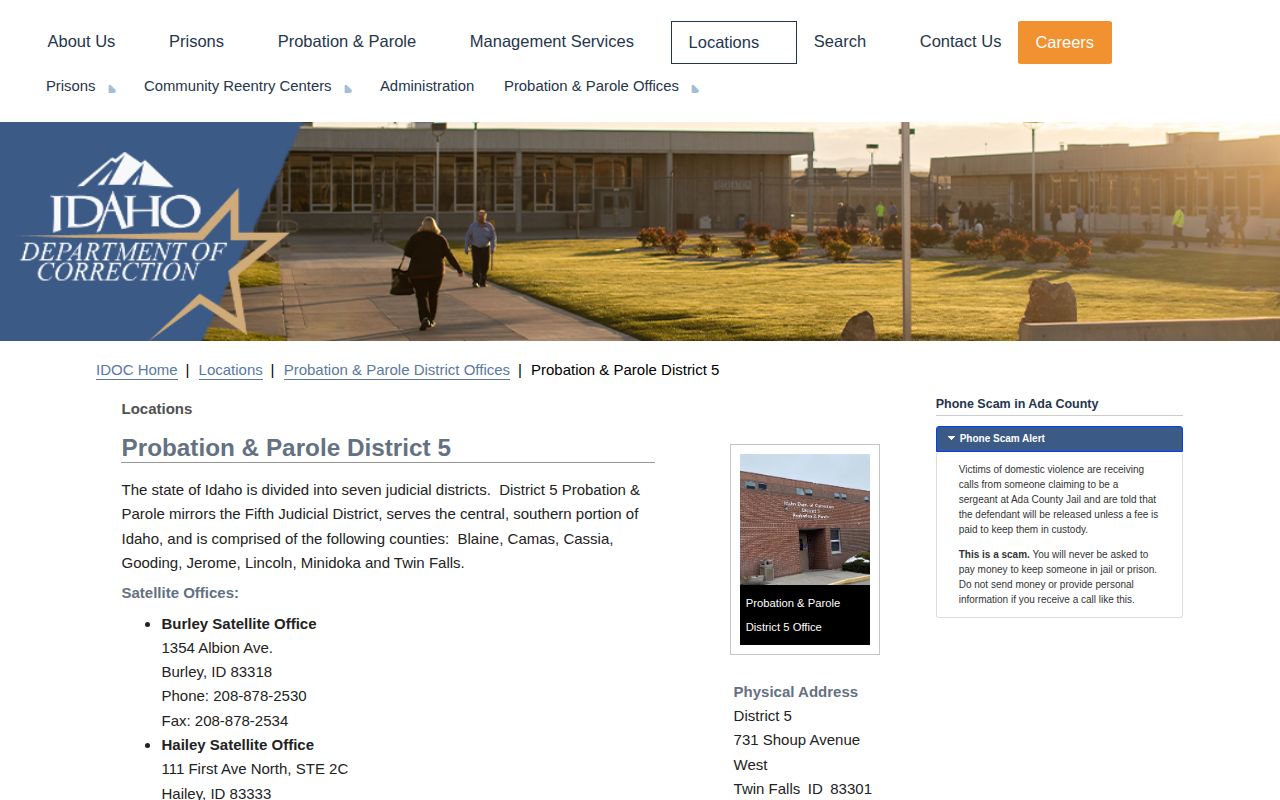
It confirms the named district serving Jerome County and provides the agency route for current office details.
Jerome County Supervision Warrants
Conditions are rules attached to community supervision. They can address reporting, travel, programs, contact, and compliance with law, but the actual order controls. A suspected violation may produce review, arrest, a bench warrant, or a Commission revocation process. It does not automatically mean the person has been discharged or returned to prison.
An IDOC result marked Active Bench Warrant, fugitive, or absconder-type status means supervision is unresolved. The person may be outside a facility while still under state authority. Jerome County also links an official active-warrants report, which is a separate county channel and may concern a local court matter rather than the same IDOC case.
VINE is useful for custody-change notices, including release and transfer, but it does not replace the supervision record. A transfer alert means custody continued elsewhere. An IDOC or Commission record is needed to interpret parole, revocation, and discharge.
Jerome County Supervision Discharge
Discharge is different from release to parole. Release to supervision ends physical prison custody but begins community control. Discharge ends IDOC jurisdiction for the identified case. The public results page may retain the person’s name and show “Discharged” with a date even when older conviction detail is suppressed.
Multiple cases can end on different dates. Read each case, then compare the sentence satisfaction entry with iCourt when the public result is brief. Idaho Court Administrative Rule 32 permits many court records to be public but protects defined material. A sealed or Clean Slate-shielded case may return no public result, so silence is not proof that supervision never existed.
When the public entry is too short, request the record from the right custodian. IDOC Public Records handles state correction material. The Commission has a separate request route for action records or summary minutes. The Jerome clerk handles judicial records under Rule 32. Each office owns a different part of the history.
Jerome Release Reentry Custody
The Twin Falls Community Reentry Center serves the Magic Valley and can house up to 160 minimum-custody IDOC residents nearing release. Placement there is still custody. A person should not be called released merely because the location is a community reentry center or because it is outside Jerome County.
Actual state-prison release is confirmed when IDOC changes to “In community,” identifies Parole, and supplies Released to Supervision. Final completion is a later discharge event. The center is a regional option, not the destination for every Jerome County case.
Jerome Release Property and ID
Jerome County’s permanent inmate case file can include release orders, dates, and a release receipt that records the return of property. That receipt can help document the physical-exit stage when an online roster has already refreshed. Request it from the Sheriff’s Office with the booking identifiers and date range.
The county resource directory also places driver’s-license and identification services at the Sheriff’s Office complex on Tiger Drive. This provides a local route for document replacement after release. Call 208-595-3300 to confirm the documents, appointment rules, and current hours before going.
Property return and identification replacement do not establish parole status. They solve practical record and document needs. IDOC remains the source for the current supervision office and case status.
Jerome Parole Date Sequence
Idaho publishes a sequence, not one universal release date. An incarcerated record may show a Parole Eligibility Date, a Next Parole Hearing Date, and a Sentence Satisfaction Date. Commission notices may add a Tentative Parole Date. None alone proves release.
The sound sequence is Commission hearing order, Notice of Action Taken, conditional tentative date, and then an IDOC update after the date. Seek “In community,” “Parole,” and “Released to Supervision” together. A detainer-only grant may instead send the person to another custodian.
Commission notices can record grant, denial, continuance, pass to full term, revocation, new parole, or detainer-only outcomes. Read the exact outcome. If the public fields conflict, request the official IDOC or Commission record rather than choosing the most favorable date.
Jerome Parole Hearing Records
The Commission hearing schedule lists sessions and daily orders. Dates and times can change. Search by name or IDOC number, then compare the result with the later Notice of Action Taken, which the Commission generally posts by the end of business Friday after the individual hearing.
A hearing listing proves that a matter was set, not that parole was granted. A grant remains subject to conditions and does not prove prison exit. The later IDOC community entry is the event check. A denial, continuance, or pass to full term explains why the expected release sequence did not advance.